

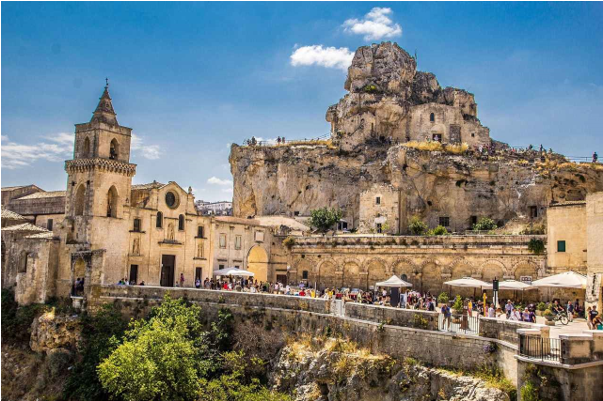
Encountering a City Still in Use
Matera doesn’t feel like a place that was restored and reopened. It feels like a place that paused, then cautiously resumed. The first view of the old town is dramatic, yes, but the effect fades quickly once you step inside. What remains is something less spectacular and more absorbing: a city that still has to function, despite its age and visibility.
Culture here isn’t something you enter. It’s something you navigate.
The Sassi as a Living System
The Sassi are often described as cave dwellings, but that definition is too neat. They operate as an urban system carved into stone, where vertical and horizontal life overlap constantly. Roofs double as streets. Staircases belong to multiple households. Boundaries blur.
This spatial complexity shapes behavior. You slow down not out of reverence, but necessity. Orientation comes through repetition. After a while, you stop trying to “figure it out” and start trusting familiarity. Culture here is learned physically, not intellectually.
Sacred Spaces That Don’t Compete
Matera’s rupestrian churches don’t dominate the skyline or announce themselves with façades. Many are almost invisible until you’re already inside them. Their entrances are modest, their interiors subdued.
Light is controlled. Frescoes appear gradually. Sound falls away. These spaces don’t attempt to impress or explain. They exist to hold silence, and they do it effectively. You leave them without a checklist completed, but with a shift in pace that lingers longer than information would.
Everyday Life as Cultural Evidence
Matera’s most convincing cultural signals are unremarkable. Laundry drying against rock walls. Plastic chairs pulled into shade. Children claiming staircases as gathering points.
These details don’t decorate the old town; they sustain it. The Sassi remain alive not because they’re admired, but because they’re still usable. Life here hasn’t been replaced by representation — and that distinction matters.
Silence as an Architectural Outcome
One of Matera’s defining qualities is its relationship with sound. Stone absorbs noise. Depth contains it. Silence feels shaped rather than empty.
This quiet isn’t curated for visitors. It’s structural — a byproduct of how the city was built and how it continues to be inhabited. For culture lovers, it creates rare clarity. Attention settles naturally when nothing competes for it.
A Culture Marked by Rupture
What distinguishes Matera from many historic towns is not continuity alone, but interruption. The Sassi were abandoned, condemned, emptied. Their rediscovery came later, and not without debate.
That history remains visible. Some areas are restored carefully, others left raw. Gaps are allowed to exist. This refusal to smooth everything into a single narrative gives the old town its tension. Culture here includes discomfort and memory, not just pride.
Moving Through as a Form of Learning
Walking in Matera is repetitive by nature. You climb, descend, retrace steps, arrive again where you thought you’d already been. Efficiency isn’t rewarded.
This movement teaches the city’s logic more effectively than explanations ever could. You begin to understand why proximity matters — why being inside the old town, crossing the same thresholds near streets and stairways, or passing areas close to hotels in Matera, alters perception. Distance here isn’t measured in minutes, but in how often a place reappears in your day.
Time Behaves Differently Here
Matera stretches time without announcing it. Mornings arrive slowly. Afternoons flatten. Evenings feel suspended rather than scheduled.
You don’t rush between points. You wait without frustration. Culture reveals itself through this altered tempo, not through events or programming. The old town teaches patience simply by functioning as it always has.
What Culture Looks Like Without Display
Matera doesn’t present culture as a sequence of highlights. It offers immersion through effort, repetition, and restraint. You don’t collect facts; you absorb atmosphere, memory, and adaptation.
You leave without a tidy summary, but with a clearer understanding of how culture can exist without performance — grounded in place, shaped by necessity, and still unfolding quietly, day after day, in stone.
